Student Testimonials
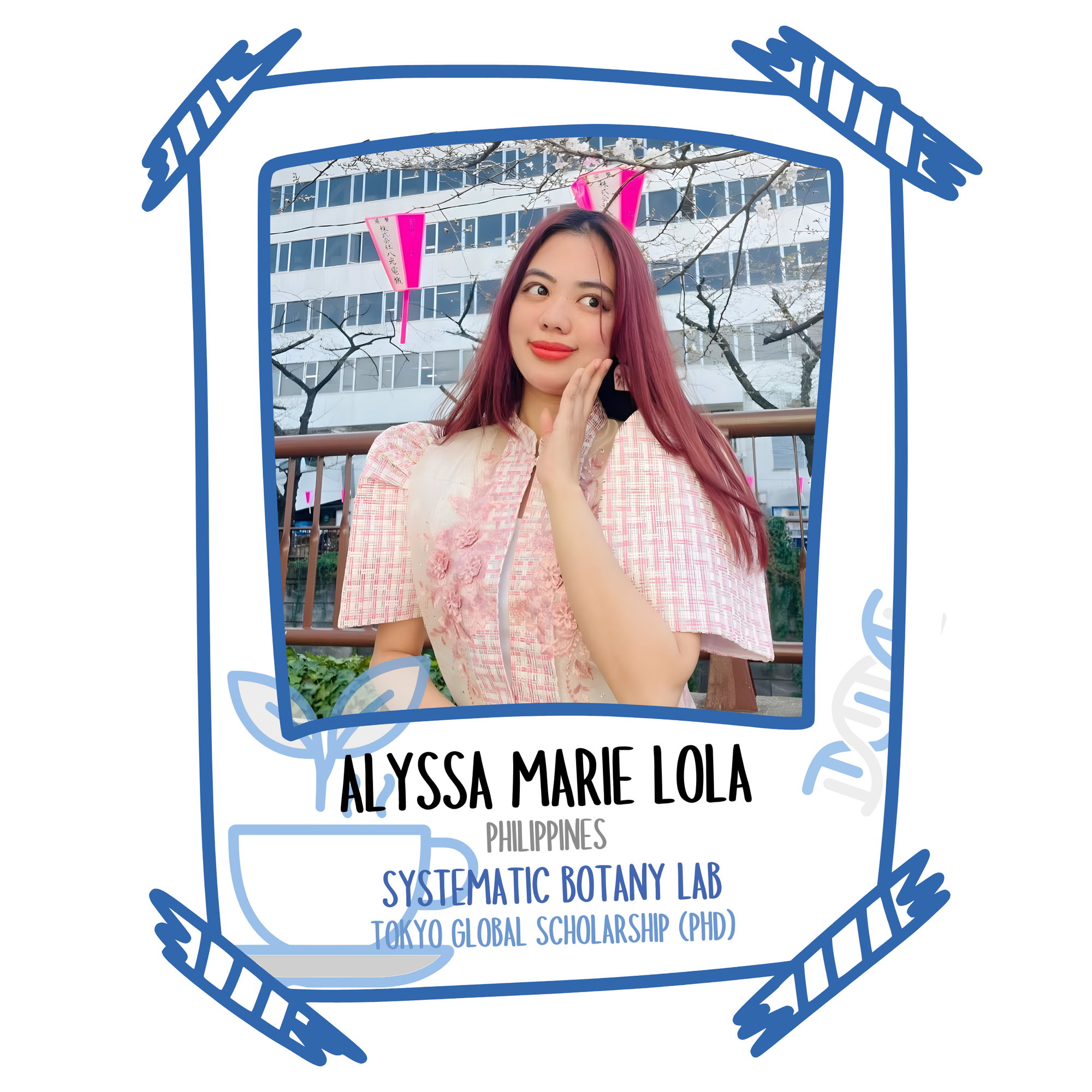
Alyssa (Systematic Botany)
How was the application and admission process in TMU?
My application and admission process to TMU was challenging but manageable. The difficulties stemmed from the fact that I applied during the pandemic, which made it hard to obtain some of the required documents. However, the process became more manageable thanks to the support I received from my supervisor and tutor in Japan, who provided valuable guidance throughout.
How was your experience adjusting to life as a foreign student in Japan?
As a foreigner living in Japan, I faced many challenges. During my first few days, I struggled with the language barrier and cultural differences, which made adjusting difficult. The transportation system was also a bit confusing at first, but as time passed, I gradually became accustomed to it. Despite these initial difficulties, I had an overall enjoyable experience in Japan. My life became much easier thanks to the support of my supervisor—who felt like a real father to me—along with my labmates, and both Japanese and Filipino friends. I especially enjoyed Japan’s vibrant culture, particularly its pop culture and anime.
How was your experience doing research as part of your laboratory?
Doing my research in Japan has been both laborious and exciting. It was laborious because, unlike in my home country, I had to work longer hours and handle more tasks. I remember the days when I had to sleep in the laboratory just to monitor my experiments around the clock. Back in the Philippines, our lab work was limited to regular hours—usually until 5:00 p.m. Despite the challenges, my research experience in Japan was also exciting. I had the opportunity to use advanced equipment and learn new techniques in molecular and hyperaccumulation analysis. I especially enjoyed learning how to operate TMU’s DNA sequencing machine and the Energy Dispersive X-ray system for my thesis.
What challenges did you face as a student and how were you able to cope with them?
As a student at TMU, I faced several challenges. First, communication with some students and professors was difficult due to the language barrier. That’s why I believe it’s very helpful to learn at least up to the Japanese Language Proficiency Test (JLPT) N4 level to communicate more freely. Second, the laboratory work and paperwork can be quite demanding, so creating a timeline and listing your tasks can make things more manageable during your stay. Lastly, meeting the expectations of my seniors was sometimes difficult, which became emotionally and mentally exhausting. However, with the support of my Japanese and Filipino friends, I was able to persevere and accomplish what I needed to do.
Would you recommend prospective students to do their graduate program in TMU?
Yes, I would definitely recommend my graduate program to other students. During my time at TMU, I was able to deepen my knowledge and enhance my skills in plant systematics, molecular biology, evolutionary biology, and plant physiology. I also gained hands-on experience using advanced laboratory equipment provided by both my lab and the university. In addition, I had the opportunity to work closely with distinguished professors in my field and present my research both locally and internationally. More importantly, the program taught me discipline and helped me become more organized in managing my daily responsibilities. Beyond academics, I met incredible people who became not just friends—or “Tomodachi”—but also my second family. I will always be grateful to my labmates, especially my supervisor, for their unwavering support and guidance.

Student Testimonials
- Nadhira (Animal Ecology)
- Fazil (Environmental Microbiology)
- Wongla (Plant Development and Physiology)
- Jun-qi (Molecular Neuroscience)
- Arifa (Cell Biochemistry)
- Alessandro (Animal Ecology)
- Alyssa (Systematic Botany)
- Zheng (Molecular Neuroscience)
- Mai (Systematic Zoology)
- Nargis (Plant Development and Physiology)
- Ermae (Animal Ecology)
- Grigorii (Molecular Neuroscience)
- Rebecca (Environmental Microbiology)
- Aini (Plant Development and Physiology)
- Sophie (Molecular Neuroscience)